Here is the fear, said plainly: doesn't stopping to negotiate rules kill the mood? Contracts and safety briefings belong at work; the bedroom is supposed to run on spontaneity and heat.
Every experienced couple in the power-exchange world will tell you the opposite, and they'll all cite the same tool. The traffic light system — three words borrowed from the street corner — is the closest thing intimacy has to a universal protocol. It takes ninety seconds to learn, it never has to interrupt anything, and paradoxically it is what makes real spontaneity possible. Clear rules don't shrink the playground. They're what let you run on it.
The Protocol Itself
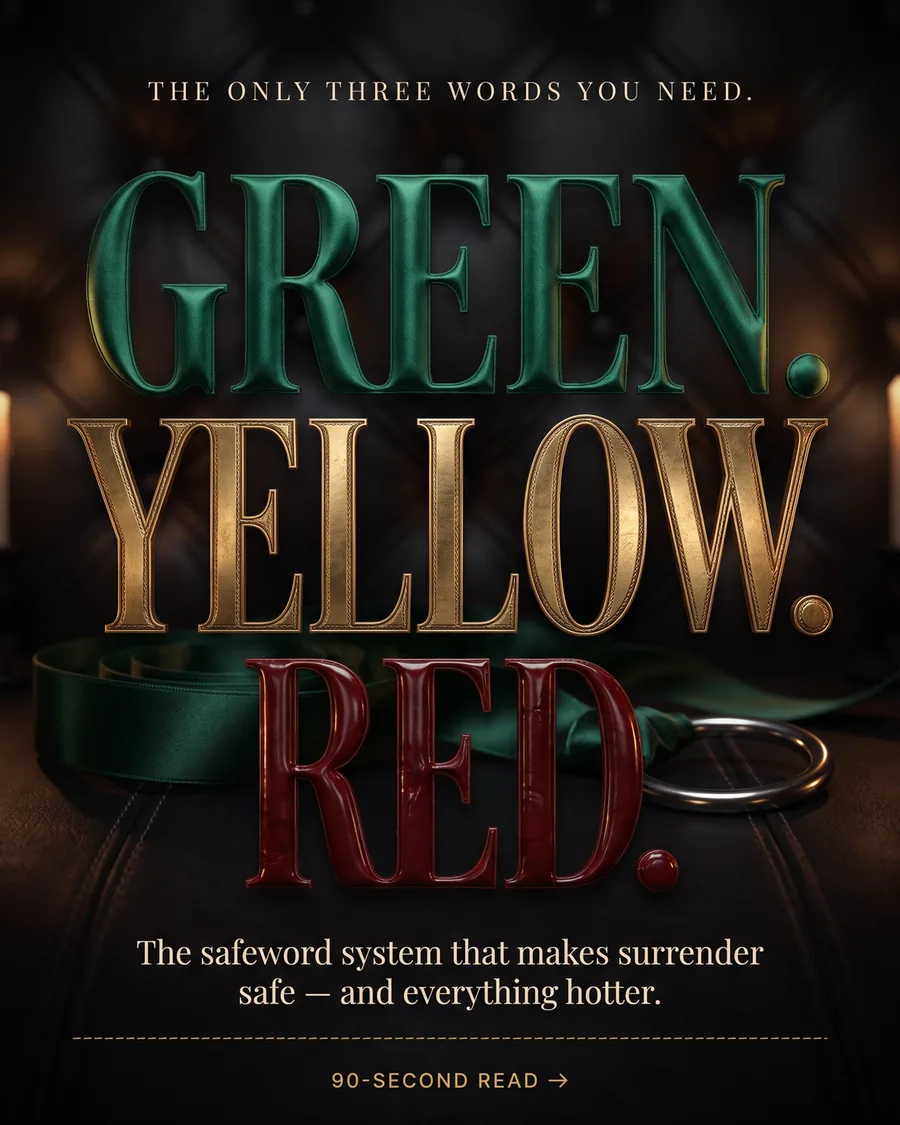
Three words, three meanings, zero ambiguity:
- GREEN — 'Yes, this, more.' An active signal of enthusiasm, not just the absence of complaint
YELLOW — 'Pause. Check in with me.' Something needs adjusting: slower, looser, a position change, a moment to breathe. Yellow is not failure; yellow is steering
RED — 'Stop everything, now.' The scene ends immediately, unconditionally, and without debate. Red is honored first and discussed after
The genius of the system is that it communicates gradations. A single safeword forces a binary — endure or emergency-stop — so people endure too long. Yellow creates the middle gear where almost all real-time steering actually happens.
Why It Works Under Pressure
In moments of high arousal or deep relaxation, complex language becomes genuinely difficult — the brain's verbal machinery is partly offline. The traffic light survives because it's monosyllabic, universally pre-understood, and impossible to mistake for role-play (unlike 'no' or 'stop', which some scenes deliberately include as theater). It is a channel that always means what it means.

The Crystal Edition
Six pieces · Hand and foot restraints, neck brace, spanker, rose gag, eye mask — in its own locking case.
Add a Non-Verbal Channel
Complete the system with one physical signal for any moment when speaking is hard: a triple tap on the mattress or your partner's arm, dropping a held object (many couples keep a small bell or ball in the bound partner's hand), or three deliberate hums. Agree on it once; it quietly guards every scene afterwards. For the partner in the free role, add the professional habit: periodically ask 'color?' — a one-word check-in that touches the scene for half a second and confirms the channel is live.
The Pre-Scene Conversation: 3 Questions in 3 Minutes
Before anything begins — ideally relaxed, earlier in the evening — cover three questions: What are we both excited to try tonight? What is off the table tonight? (a no-list requires no justification, ever), and What are our signals? — confirm the lights and the tap. Couples report something unexpected about this ritual: spoken anticipation is itself electric. Describing what you're about to do is not paperwork before the experience. It is the opening scene of it.
Boundaries Are Why It Gets Hotter
The paradox resolves once you see the mechanism. A partner unsure of the edges plays it safe everywhere — hesitant, monitoring, holding back. A partner who knows exactly where the walls are can commit fully to everything inside them. Structure doesn't compete with passion; structure is what permits abandon. Clear rules create a safe playground — and safe playgrounds are where people actually let go.
The same philosophy has reached the objects themselves. It is how we build at SIN Premium — padded cuffs, instant-release hardware, materials chosen for skin contact — boundary-thinking rendered in leather and hardware. Pairing a clear protocol with equipment engineered around the same principle of trusted limits is how modern couples elevate a private connection: everything designed, so everything can be surrendered.
After the Scene: The Debrief
Close the loop while holding each other: What was the best moment? Anything to adjust next time? Two questions, two minutes. This is where yellow moments become improvements and green moments become traditions — and where both partners learn the deepest rule of all: that everything they felt was safe to feel.
The Takeaway
Ninety seconds of shared vocabulary buys unlimited depth. Green, yellow, red, one tap signal, one three-minute conversation — that's the entire professional standard. Not a contract that kills the mood. A key that unlocks it.