There is an audience the intimate industry ignored for decades: people with taste. People whose homes hold Italian marble and linen bedding, whose wardrobes are edited, who will happily pay for quality — and who took one look at the traditional aesthetic of the category, all grommeted vinyl and dungeon-noir packaging, and simply closed the tab.
Their objection was never prudishness. It was design. If every other object you allow into your life is beautiful, why would the most intimate objects be the exception? Over the last few years, a small movement of ateliers has finally answered — and it is transforming what bedroom hardware can be.
How the Category Got Ugly
The old aesthetic wasn't accidental. Intimate gear emerged from underground subcultures whose visual codes — black leather, chrome studs, military hardware — signaled rebellion and belonging. When the category commercialized, mass manufacturers simply photocopied those codes in cheaper materials: vinyl for leather, plated alloy for steel, shock-value packaging for identity. The result read as costume, and worse, as cheap costume. For design-literate buyers, it was disqualifying.
The Fashion-House Turn
The new generation of intimate ateliers begins from a different reference library: not the dungeon, but the maison. Their vocabulary is the vocabulary of luxury accessories — saddle-stitched leather goods, jewelry-grade polished metals, freshwater pearl details, silk and velvet linings, sculptural hardware that could sit on a gallery plinth. Presentation follows suit: structured cases, tissue and ribbon, monogrammed dust bags. The unboxing resembles a purchase from a Milanese leather house, because the construction standards genuinely are those of one.
Why Aesthetics Are Not Superficial Here
In intimate objects, beauty does psychological work that function alone cannot:
Beautiful objects lower the threshold — a pearl-detailed cuff reads as romantic invitation where black tactical gear reads as ultimatum, which changes the conversation a couple can have about it
Design communicates safety — visible craftsmanship (even stitching, finished edges, weighty polished hardware) signals that the same care went into what you can't see
Objects you find beautiful get used — gear you're faintly embarrassed by lives in a box; gear you admire becomes part of your life
Aesthetic coherence protects the mood — the bedroom you composed deserves objects that belong in it
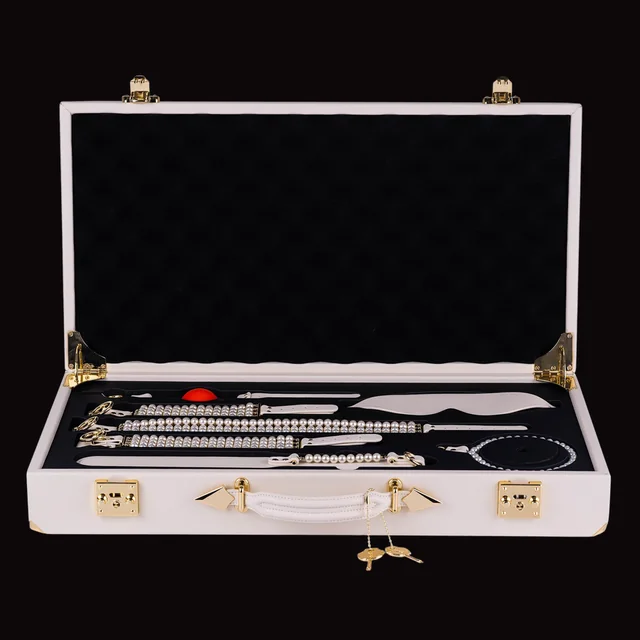
The Pearl Edition
Six pieces · Wrist and ankle cuffs, choker, blindfold, spanker, gag — pearl and gold, in a white case.
The Craft Is Real, Not Marketing
Skeptics reasonably ask whether luxury positioning is just a markup story. The verification is physical: solid metalwork instead of hollow castings, finished edges instead of raw cut ones, doubled load-bearing seams, and padded architecture shaped to anatomy. These are the same criteria by which one judges a fine handbag or a watch strap — and they are the philosophy we build SIN Premium on, treating intimate restraint explicitly as fine architectural art: sculptural forms, hardware finished to jewellery standards, engineering hidden inside elegance.
If your bedroom features Italian marble and fine linens, your gear should match — not as vanity, but as consistency.
Design as the New Discretion
An unexpected benefit of the fashion turn: objects this beautiful are ambiguous. A polished sculptural piece resting in a leather case reads as design object first; nothing about it shouts its function. For buyers to whom privacy matters, good design turns out to be better camouflage than any hiding place — elegance is its own discretion.
How to Shop the Category Like a Design Buyer
Apply exactly the standards you'd apply at a fashion house: demand named materials and origins; study the edges and stitching in photos — edges never lie; assess hardware weight and finish; expect presentation (case, packaging) commensurate with the price; and dismiss anything hiding behind moody photography without specification. Taste, it turns out, is a fully transferable skill.
The Takeaway
You were never wrong to reject ugly gear — you were early. The category has finally produced objects that meet the standard the rest of your life is built on. The bedroom was the last room waiting for good design. It isn't waiting anymore.